a class for representing a Integral calculations and their derivatives More...
#include <integral.hpp>
Public Types | |
| using | eval_func = std::function< void(double, const std::vector< const double * > &, double *, bool)> |
| signature of integral evaluation kernel | |
| using | jacobian_vector_product_func = std::function< void(const double *, double *)> |
| signature of element jvp kernel | |
| using | grad_func = std::function< void(ExecArrayView< double, 3, ExecutionSpace::CPU >)> |
| signature of element gradient kernel | |
Public Member Functions | |
| Integral (const Domain &d, std::vector< uint32_t > trial_space_indices) | |
| Construct an "empty" Integral object, whose kernels are to be initialized later in one of the Make****Integral free functions below. More... | |
| void | Mult (double t, const std::vector< mfem::BlockVector > &input_E, mfem::BlockVector &output_E, uint32_t differentiation_index, bool update_state) const |
| evaluate the integral, optionally storing q-function derivatives with respect to a specific trial space. More... | |
| void | GradientMult (const mfem::BlockVector &dinput_E, mfem::BlockVector &doutput_E, uint32_t differentiation_index) const |
| evaluate the jacobian(with respect to some trial space)-vector product of this integral More... | |
| void | ComputeElementGradients (std::map< mfem::Geometry::Type, ExecArray< double, 3, ExecutionSpace::CPU > > &K_e, uint32_t differentiation_index) const |
| evaluate the jacobian (with respect to some trial space) of this integral More... | |
| bool | DependsOn (uint32_t which) const |
returns whether or not this integral depends on argument which More... | |
Public Attributes | |
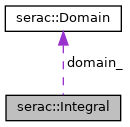
| Domain | domain_ |
| information about which elements to integrate over | |
| std::map< mfem::Geometry::Type, eval_func > | evaluation_ |
| kernels for integral evaluation over each type of element | |
| std::vector< std::map< mfem::Geometry::Type, eval_func > > | evaluation_with_AD_ |
| kernels for integral evaluation + derivative w.r.t. specified argument over each type of element | |
| std::vector< std::map< mfem::Geometry::Type, jacobian_vector_product_func > > | jvp_ |
| kernels for jacobian-vector product of integral calculation | |
| std::vector< std::map< mfem::Geometry::Type, grad_func > > | element_gradient_ |
| kernels for calculation of element jacobians | |
| std::vector< uint32_t > | active_trial_spaces_ |
| a list of the trial spaces that take part in this integrand | |
| std::map< uint32_t, uint32_t > | functional_to_integral_index_ |
a way of translating between the indices used by Functional and Integral to refer to the same trial space. More... | |
| std::map< mfem::Geometry::Type, GeometricFactors > | geometric_factors_ |
| the spatial positions and jacobians (dx_dxi) for each element type and quadrature point | |
Static Public Attributes | |
| static constexpr std::size_t | num_types = 3 |
| the number of different kinds of integration domains | |
Detailed Description
a class for representing a Integral calculations and their derivatives
Definition at line 25 of file integral.hpp.
Constructor & Destructor Documentation
◆ Integral()
|
inline |
Construct an "empty" Integral object, whose kernels are to be initialized later in one of the Make****Integral free functions below.
- Note
- It is not intended that users construct these objects manually
- Parameters
-
d the domain of integration trial_space_indices a list of which trial spaces are used in the integrand
Definition at line 38 of file integral.hpp.
Member Function Documentation
◆ ComputeElementGradients()
|
inline |
evaluate the jacobian (with respect to some trial space) of this integral
- Parameters
-
K_e a collection (one for each element type) of element jacobians (num_elements x trial_dofs_per_elem x test_dofs_per_elem) differentiation_index the index of the trial space being differentiated
Definition at line 114 of file integral.hpp.
◆ DependsOn()
|
inline |
returns whether or not this integral depends on argument which
- Parameters
-
which an argument index
- Returns
- true when if this Integral object was created with a DependsOn<...> statement that includes
i
Definition at line 131 of file integral.hpp.
◆ GradientMult()
|
inline |
evaluate the jacobian(with respect to some trial space)-vector product of this integral
- Parameters
-
dinput_E a block vector (block index corresponds to the element geometry) of a specific trial space element values doutput_E a block vector (block index corresponds to the element geometry) of the output values for each element. differentiation_index a non-negative value indicates directional derivative with respect to the trial space with that index.
Definition at line 94 of file integral.hpp.
◆ Mult()
|
inline |
evaluate the integral, optionally storing q-function derivatives with respect to a specific trial space.
- Parameters
-
t the time input_E a collection (one for each trial space) of block vectors (block index corresponds to the element geometry) containing input values for each element. output_E a block vector (block index corresponds to the element geometry) of the output values for each element. differentiation_index a non-negative value indicates differentiation with respect to the trial space with that index. A value of -1 indicates no differentiation will occur. update_state whether or not to store the updated state values computed in the q-function. For plasticity and other path-dependent materials, this flag should only be set to trueonce a solution to the nonlinear system has been found.
Definition at line 66 of file integral.hpp.
Member Data Documentation
◆ functional_to_integral_index_
| std::map<uint32_t, uint32_t> serac::Integral::functional_to_integral_index_ |
a way of translating between the indices used by Functional and Integral to refer to the same trial space.
e.g. A Functional may have 4 trial spaces {A, B, C, D}, but an Integral may only depend on a subset, say {B, C}. From Functional's perspective, trial spaces {B, C} have (zero-based) indices of {1, 2}, but from Integral's perspective, those are trial spaces {0, 1}.
So, in this example functional_to_integral_index_ would have the values:
Definition at line 180 of file integral.hpp.
The documentation for this struct was generated from the following file:
- src/serac/numerics/functional/integral.hpp